
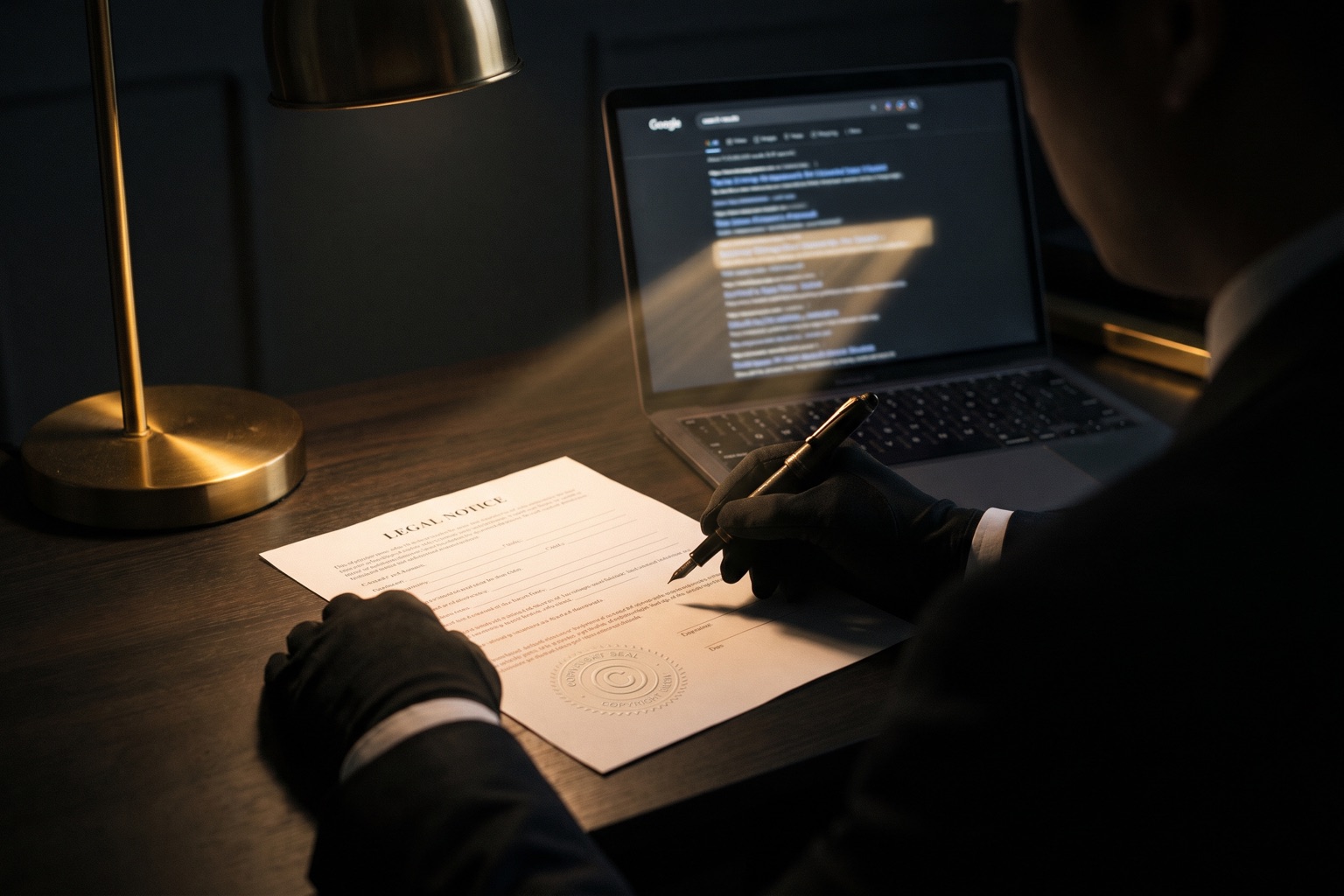
At the bottom of some Google results pages there is a line: "In response to a complaint we received under the US Digital Millennium Copyright Act, we have removed 1 result(s) from this page." That is a DMCA takedown — one of the fastest ways to get a page out of Google. But it works in exactly one situation: when the page uses, without permission, something you hold the copyright to. Below: how the procedure works, when it applies to reputation problems, and when it turns into a risk for the person who filed.
What the DMCA is and what it has to do with search results
The Digital Millennium Copyright Act is a 1998 US copyright law. Its Section 512 created the notice-and-takedown mechanism: a copyright owner sends an online service a notice of infringement, the service removes or disables access to the material, and in exchange it keeps its "safe harbor" from liability for what its users post. Google is a US company and applies this procedure across its products — web search, Images, YouTube, Blogger — regardless of where the complainant or the website is located. That is why a DMCA notice works for a rights holder in London, Berlin or Dubai just as it does for one in New York.
It matters what exactly Google removes. A search engine does not control someone else's website, so a successful notice delists the URL from search results — the page itself stays on its server and still opens by direct link. Only when the infringing copy is hosted on Google's own services (YouTube, Blogger, Google Sites, Drive) is the content itself taken down.
The DMCA protects copyrighted works only: text, photographs, video, illustrations, music, software code. Facts, names, news events and someone's opinion of you are not copyrightable — and cannot be removed this way.
When a DMCA takedown fits a reputation problem
In reputation work the DMCA is a narrow but strong tool. It applies where the damaging page is built on your own content, copied without permission:
- Your photos on someone else's site. Pictures you took yourself (selfies included), or images whose rights belong to your company or were assigned to you by the photographer. A typical case is a smear site or a fake profile illustrated with your personal photos. One caveat that surprises people: copyright belongs to whoever pressed the shutter, not to the person in the picture. Being the subject of a photo does not make you its owner.
- Your writing. Copied articles, posts, private messages or emails that you authored. Reposting your letter on a forum is a privacy problem and a copyright problem at once.
- Video and recordings of talks whose rights belong to you or your organization.
- Clone and mirror sites. A copy of your website, or a page where fake "reviews" are mixed with your original text and images. Scraper sites that republish your content word for word fall here too.
The DMCA will not help when the unpleasant article was written by a journalist, the review was left by a customer, the mugshot was published by a public agency, or the photo was taken by a third party at a public event. You do not own those works. Other levers exist for them: a privacy or data-erasure request, a defamation claim, the right to be forgotten in the EU and UK, or pushing the page out of the first results.
Prove ownership
Find the original: the source file with metadata, the earliest publication, a contract or licence from the photographer or author. Without proof of ownership a notice should not be filed.
Collect the URLs
List the exact infringing URLs — not the whole domain, but every page that carries the copy — plus a link to the original work.
Send the notice
First to the site owner and the hosting provider, then to Google through its copyright removal form, with a description of the work and the required sworn statements.
Watch the results
Track the delisting, copies resurfacing at new addresses and a possible counter-notification from the site owner.
How to file a DMCA takedown with Google: step by step
- Document the infringement. Dated screenshots, saved copies of the pages, a list of URLs. You will need them for the notice and for any later claim against the site owner.
- Go to the source first. A message to the site owner and the hosting provider often removes the material itself, not just the Google link — and that also takes it out of Bing and other search engines. Most hosts and platforms publish a DMCA or abuse contact; the host can be identified through WHOIS and IP lookup.
- Complete Google's form. The request is filed through Google's legal removals help pages ("Report content for legal reasons"): you choose the product (Search, Images, YouTube), describe the copyrighted work, link to the original and list the infringing URLs. A Google account is required.
- Sign the statements. The law requires specific elements: identification of the work and of the infringing material, your contact details, a statement that you believe in good faith the use is not authorized, a statement — under penalty of perjury — that the notice is accurate and that you are the owner or authorized to act for the owner, and a signature.
- Wait for the decision. Google reviews the notice and replies by email. Approved URLs disappear from results, and a line about the DMCA removal may appear at the bottom of the results page.
Google does not publish a fixed processing time. Clear-cut copying is usually handled quickly; disputed cases take longer or come back with a request for more information. Before filing, consider whether the use could be fair use — quotation for criticism, commentary or news reporting. A US appeals court has held that rights holders must consider fair use before sending a takedown notice, and a notice aimed at a critical review that quotes two lines of your text is the kind that gets rejected or challenged.
"A DMCA takedown works exactly when you can prove the work is yours. If you cannot prove it, it is not your tool — and trying to use it anyway creates a problem worse than the one you started with."
What happens after you file: Lumen and the counter-notice
The procedure has two features that are rarely explained in advance.
It is public. Google shares removal notices with Lumen, an open research database run by the Berkman Klein Center for Internet & Society at Harvard University. The notice at the bottom of Google's results links there. Personal contact details are redacted, but the removed URLs and, in many cases, the name of the complainant or the organization that filed remain searchable. The complaint itself can therefore become a new trace. If the goal is to quietly retire sensitive material, this has to be weighed before filing — and it is one reason notices are often submitted by an authorized representative.
It can be contested. The site owner may file a counter-notification stating that the material was removed by mistake or that the use is lawful. Under the DMCA's put-back rules, removed material may then be restored in roughly 10 to 14 business days unless the rights holder files a court action; Google says it may reinstate content when it receives a valid counter-notice. This is why the DMCA works better against anonymous scraper sites and clones than against publishers who are ready to defend themselves.
 See also · Deindexing
The Right to Be Forgotten: How to Legally Remove Links from Google and Yandex
When you hold no copyright but the information is inaccurate or outdated: grounds, procedure and typical refusals.
Read the article →
Fake DMCA notices: why "guaranteed removal" is dangerous
The content-removal market has a well-known scheme built on forged complaints. The contractor copies the inconvenient article to a throwaway site, backdates it, and then files a DMCA notice against the original as if it were the copy — in the name of a fictitious "rights holder". Sometimes the link really is delisted for a while.
The consequences land on the client:
- Liability. Section 512(f) of the DMCA makes anyone who knowingly misrepresents that material is infringing liable for damages, including the other side's legal costs, and the notice itself is signed under penalty of perjury.
- Exposure. The notice lands in Lumen. Journalists and researchers routinely find forged notices there and write about them — the story of an attempt to bury an article becomes new, more visible negative coverage.
- The link comes back. The newsroom files a counter-notification, the URL returns, and the results for your name gain articles about the falsification.
If a vendor promises to "remove any article through the DMCA", treat it as a red flag. The only thing the DMCA lawfully removes is content you actually own.
Beyond Google: Bing, hosts and non-US platforms
A Google notice affects Google only. Bing — which also feeds results to other search engines and AI assistants — has its own copyright infringement form, and the page will keep appearing there until you file separately. Hosting providers, registrars, social networks and CDNs each run their own DMCA or abuse channel; removing the copy at the host is what makes it disappear everywhere at once.
The DMCA is American law, and services outside the US are not bound by it. In the EU, hosting providers and platforms must offer a notice-and-action mechanism for illegal content under the Digital Services Act, and most European hosts act on well-founded copyright complaints. In Russia, Yandex applies its own rules and has a separate copyright complaint form. In practice this means one complaint per search engine and per host, each under its own procedure.
One more distinction: intimate images published without consent do not require a copyright argument at all. Google has a dedicated removal process for non-consensual explicit imagery, and in the United States the Take It Down Act has, since May 19, 2026, required covered platforms to remove such images within 48 hours of a valid request.
| Situation | Does the DMCA apply? | What works instead or alongside |
|---|---|---|
| Your personal photos on a smear site | Yes, if you took the pictures or own the rights | Complaint to the host, privacy or data-erasure request |
| Your messages or writing reposted without permission | Yes, you are the author | Platform report for a privacy violation |
| A critical article about you by a journalist | No | Correction request, defamation claim if the facts are false, right to be forgotten (EU/UK), suppression |
| A negative customer review | No | Report under the platform's own policies, a public response, work on the overall rating |
| A clone of your website with fake content | Yes, for the copied material | Complaints to the registrar and host, monitoring for new mirrors |
| Intimate images shared without consent | Only if you created the image | Google's explicit-imagery removal process, platform reports, Take It Down Act requests in the US |
The DMCA as part of a strategy, not a standalone fix
Even a successful DMCA takedown closes only specific URLs in Google. Copies on other sites, snapshots in web archives and retellings that do not use your content are untouched. That is why, in SEO reputation projects, we treat the DMCA as one lever among several: first we check what the client genuinely owns, then remove what is lawfully removable, and then push the remaining material out of the top results for the name or brand and put it under monitoring.
For how removal and suppression fit together, see our guides on removing negative content from the internet and on removing content from web archives and caches.
 Service
Online Content Removal
Discuss →
Frequently Asked Questions
It is the removal of a page from Google's search results after a copyright owner files a notice under the US Digital Millennium Copyright Act. The link stops appearing in search, but the page stays on the website unless the site owner or hosting provider removes it.
Only if the article uses your content without permission: your photographs, your writing or your video. A journalist's article about you, a customer review or a news report is not your work, so the DMCA does not apply. For those, the options are a defamation claim, the right to be forgotten in the EU and UK, and suppression in search results.
In most cases, yes. Google shares removal notices with the public Lumen database, where the removed URLs and often the name of the complainant can be looked up. If confidentiality matters, the notice can be filed by an authorized representative, and the step should be assessed in advance as a possible new trace online.
Google does not publish a fixed timeframe. Clear cases of copying are usually processed quickly, while disputed ones take longer or lead to a request for more information. If the site owner files a counter-notification, the link may be reinstated unless the rights holder goes to court.
You can file with Google from any country, because Google applies the procedure worldwide. But each notice covers one service: Bing, hosting providers and social networks have their own forms, and services outside the US follow their local rules, such as notice-and-action under the EU Digital Services Act.
A notice is signed under penalty of perjury, and Section 512(f) of the DMCA makes knowing misrepresentation a basis for liability. Forged notices end up in the public Lumen database, journalists find them, and the attempt to hide a page becomes a new and louder negative story.